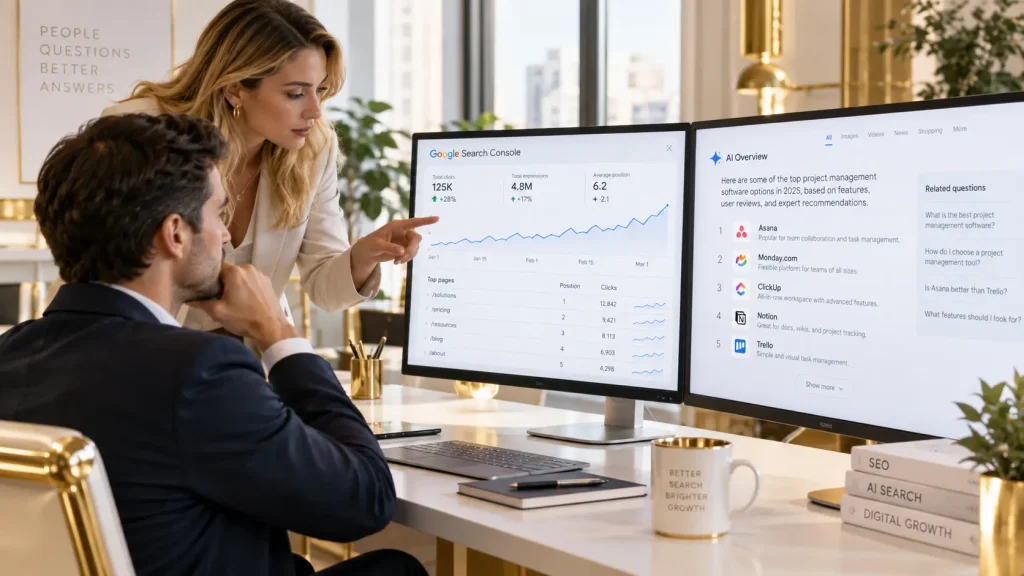

You may already be ranking on Google, publishing helpful content, and following SEO best practices, but what happens when your competitors are the ones showing up in AI-generated answers instead of you?
As more people use AI-powered search to compare businesses, research services, and make decisions, traditional search rankings are no longer the only place where visibility matters. If your brand is missing from AI-generated recommendations, comparisons, and citations, you could be losing valuable opportunities to competitors who are easier for AI systems to understand and surface.
This is where generative engine optimization comes in.
GEO helps make your content clearer, more relevant, and easier for AI-powered search systems to interpret, reference, and include in their responses. For Canadian businesses, it creates another opportunity to stay visible as the way people search continues to evolve.
In this guide, we’ll break down how GEO works, how it complements traditional SEO, and the practical steps businesses can take to improve their visibility across AI-powered search.
What is Generative Engine Optimization?
Generative engine optimization, or GEO, is the practice of improving your content and online presence so your business has a better chance of being cited, mentioned, or recommended in AI-generated answers. Instead of only competing for a position on a search results page, GEO also focuses on becoming part of the answer itself.
This means creating useful, relevant, and credible information that AI-powered search systems can easily understand and connect to a user’s question.
GEO does not require businesses to abandon proven SEO practices. Google confirms that strong SEO foundations, including valuable content and a clear technical structure, remain important for visibility in generative AI search.
How GEO Works
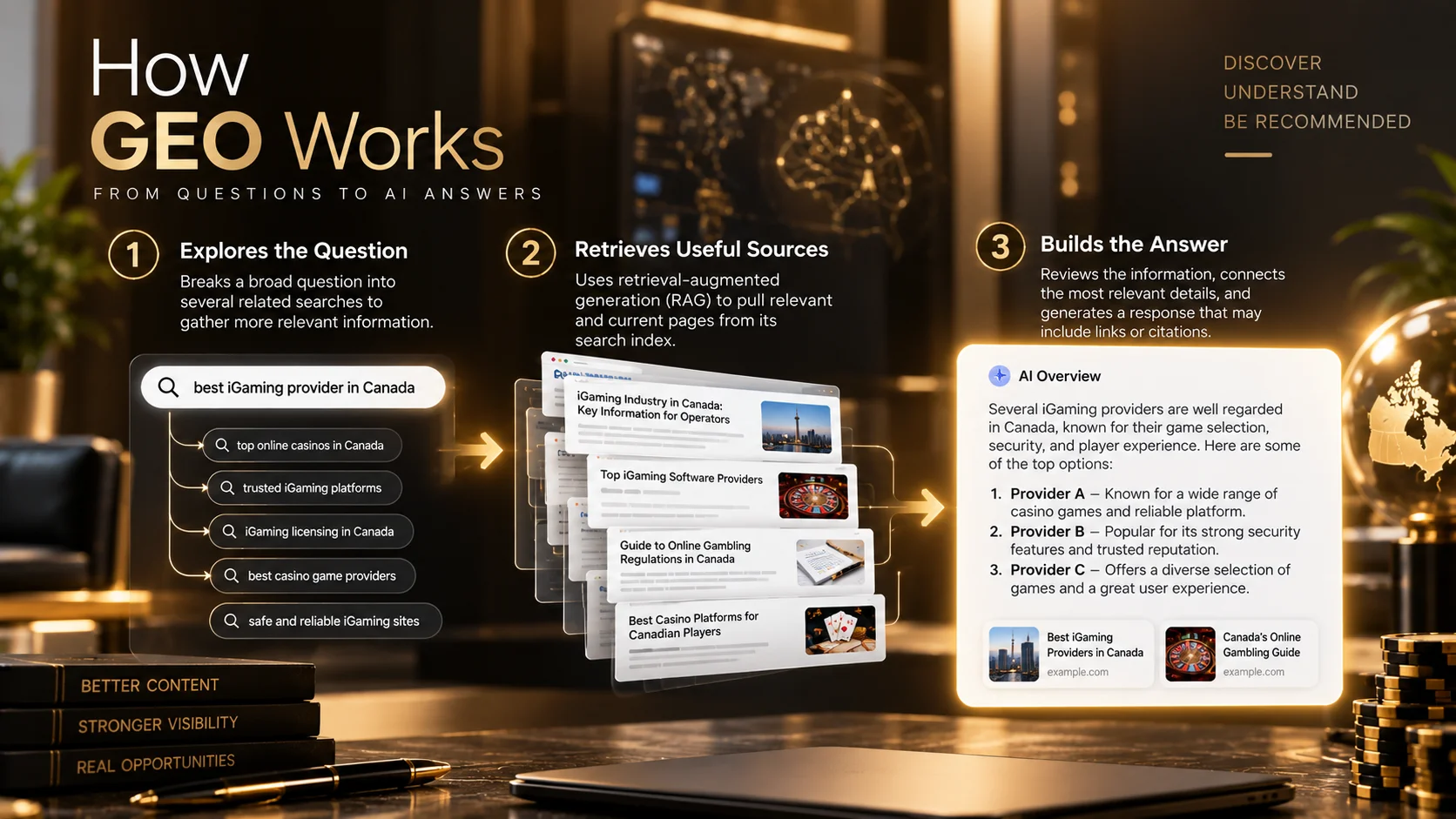
GEO works by helping AI-powered search systems find, understand, and use your content when building an answer. The exact process varies by platform, but Google gives us a useful look at how this can work through AI Overviews and AI Mode.
- The system explores the question. Google may use query fan-out to break a broad question into several related searches and gather more relevant information.
- It retrieves useful sources. Through retrieval-augmented generation, or RAG, Google can pull relevant and current pages from its Search index to support the response.
- It builds the answer. The system reviews information from those sources, connects the most relevant details, and generates a response that may include links or citations.
This is why GEO is not about inserting more keywords. Your content needs to clearly answer real questions and provide information worth using in generative AI search.
SEO and GEO: Different Goals, Shared Foundations
SEO and GEO work toward the same goal: helping people discover useful and relevant content. The main difference is where that visibility happens.
SEO focuses on:
- Traditional search rankings
- Organic clicks and traffic
- Keywords, technical SEO, links, and content quality
- Conversions from search results
GEO focuses on:
- Visibility in AI-generated answers
- Brand mentions, citations, and recommendations
- Clear context, authority, and useful information
- Visibility across AI-powered search experiences
In practice, AI SEO optimization builds on strong SEO foundations while helping content become easier for AI systems to understand, reference, and surface.
For Canadian businesses, the goal is to make SEO and GEO work together so your brand can stay visible across both traditional and AI-powered search.
Generative Engine Optimization Strategies
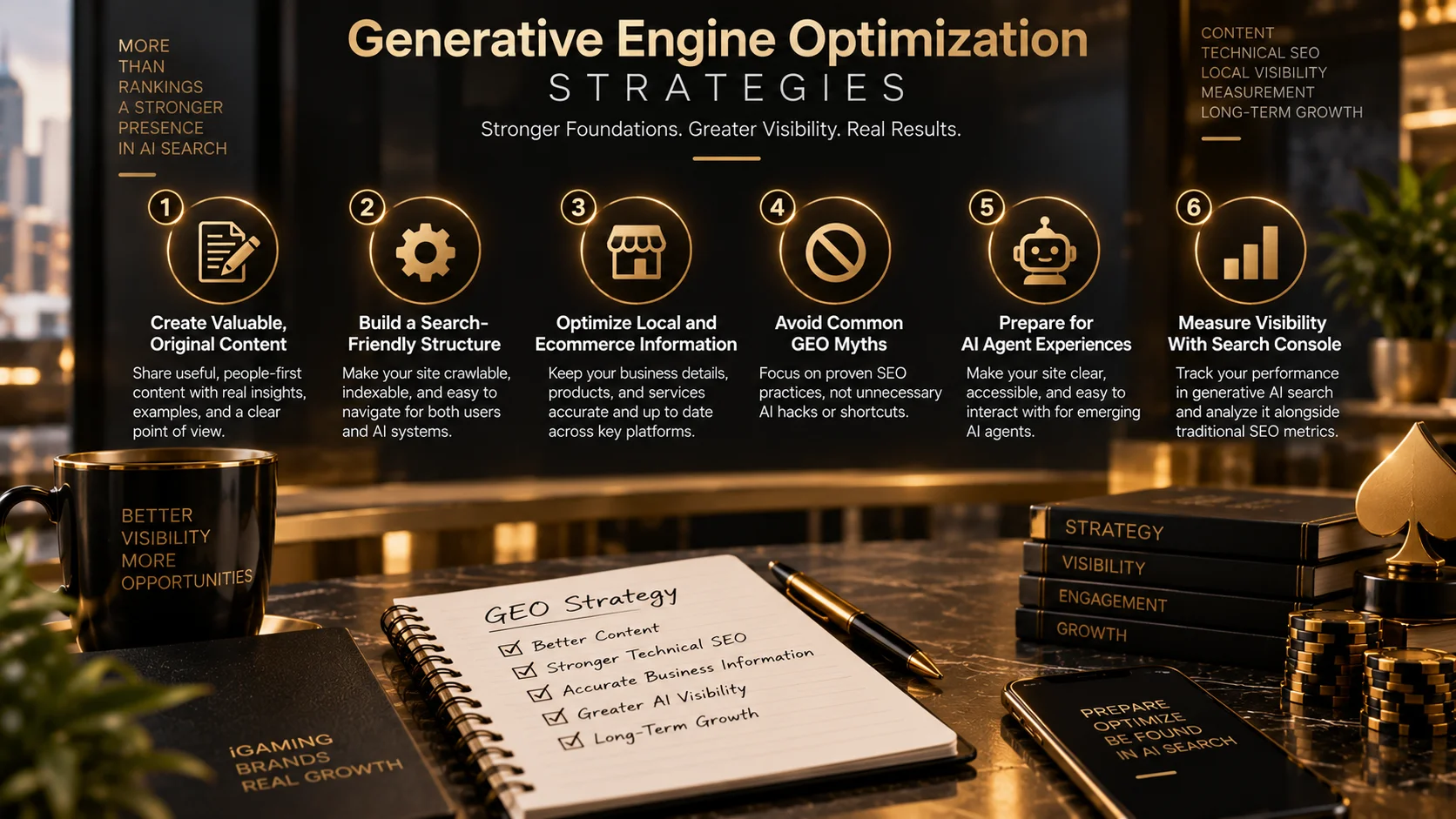
Effective GEO is less about finding new AI tricks and more about strengthening the SEO practices that already make your website useful, accessible, and trustworthy. Google recommends focusing on strong content, technical foundations, accurate business information, and meaningful measurement.
Create Valuable, Original Content for Your Audience
Give readers a reason to choose your content over dozens of similar pages. Google recommends creating helpful, people-first content that adds something original rather than simply repeating what is already available online.
Focus on:
- First-hand experience and expert insight
- Original examples, research, or data
- A clear and useful point of view
- Content organized around what readers actually want to know
If you use generative AI tools, review the final output carefully. Generative AI content should still be accurate, useful, and valuable enough to satisfy real readers.
Build a Clear and Search-Friendly Technical Structure
Good content cannot perform well if search systems struggle to access it. Pages need to be crawlable, indexable, and eligible to appear in Google Search before they can be considered for Google’s generative AI features.
Keep an eye on:
- Crawlability and indexing
- Clear site and page structure
- Mobile usability and page experience
- JavaScript SEO where applicable
- Duplicate content and unnecessary URLs
These foundations make it easier for both users and search systems to navigate and understand your website.
Optimize Your Local Business and Ecommerce Information
For local and e-commerce businesses, accurate information can create more opportunities to appear in both traditional and AI-powered results.
Make sure you maintain:
- Google Business Profile details
- Locations and opening hours
- Products and services
- Merchant Center product data
- Other important customer-facing business information
Google notes that Business Profiles and Merchant Center can help products and services appear in generative AI responses as well as other search results.
Avoid Common GEO Myths and Unnecessary AI Hacks
Not every new GEO tactic deserves a place in your strategy. For Google Search, you do not need to:
- Create a new llms.txt file to improve Google visibility
- Break content into tiny chunks just for AI to better understand it
- Rewrite pages specifically for AI systems
- Avoid inauthentic brand mentions
- Add special schema solely for generative search
Google recommends sticking with useful content and proven SEO practices instead of chasing shortcuts that promise quick AI visibility.
Prepare Your Website for Emerging AI Agent Experiences
AI agents are moving beyond answering questions. They can compare products, gather information, navigate websites, and complete certain actions on behalf of users.
For businesses, this means your website may need to serve both people and AI agents. Clear navigation, structured information, accessible pages, and easy-to-complete actions can help these systems understand what you offer and interact with your site more effectively.
Preparing for this now can put your business in a stronger position as agentic search and browsing experiences continue to develop.
Measure Generative AI Visibility With Search Console
GEO should not stop at optimization. You also need to understand whether your content is actually gaining visibility.
Google recommends using the Generative AI performance report in Search Console to see how people discover your content through its generative AI features.
At Top Premier Cloud, we look at this alongside traditional SEO metrics such as traffic and engagement. This gives businesses a clearer view of how their visibility is developing across both established and newer search experiences.
Is GEO Replacing SEO?
No. GEO is not replacing SEO. It is expanding how businesses can build visibility online.
SEO still does the heavy lifting by helping search engines find, understand, and rank useful content. GEO builds on that foundation by improving the chances that your content is also used in AI-generated answers.
For Canadian businesses, this matters because customers may compare providers, services, and local options across both traditional search and AI-powered tools. If your brand is visible in only one, you could be missing part of the buying journey.
At Top Premier Cloud, we see the stronger approach as combining solid SEO with GEO so businesses can stay discoverable as search behaviour continues to evolve.
GEO Prepares Your Brand for AI-Powered Search

For iGaming businesses and other Canadian businesses competing in crowded markets, visibility now extends beyond Google rankings. Customers are also using AI-powered search to compare options, discover brands, and make decisions.
Start with the basics:
- Strengthen your SEO foundation
- Improve the quality and clarity of your content
- Keep your business information accurate
- Track your visibility across traditional and AI-powered search
At Top Premier Cloud, we help businesses build on proven SEO practices while adapting for AI-driven search.
Make your brand ready for AI-powered search. Talk to Top Premier Cloud about building a practical GEO strategy that supports long-term visibility.